Showing posts with label Baku. Show all posts

Wednesday, July 2, 2014

Gala Kend and Family

Another day of Social Entrepreneurship training- and I have a comment on why I haven't said much about it. You see, this training was incredible. Not only was our speaker, Mr. Togrul Alakbar, captivating and intuitive, but everything he spoke about was so inspiring and his presentations alone are the main reason to why I've decided to go down the track of social work. And as much as I would love to pass along all the insight he gave our little group, I would never be able to accurately capture all that he taught, and he deserves more credit than I can give. 

I woke up super early this morning to get to said training- although we still arrived late- after this lovely breakfast my host mother made for me. 


Jam, always jam. 
An omelette with "greens"- more on this later.


*Side note- In Azerbaijan, it's super rare to have pets, especially in the city. There just isn't enough room. But I saw so many stray animals, some in good condition and others not so much. Kittens were more taken care of, but dogs suffered more. While no locals seemed to even notice the stray animals due to it being a normality, my heart was in pain every time I saw one. However, my family did have a dog. He lived outside, which he had plenty of room to run around it, but wasn't incredibly groomed. I felt kind of bad for the guy, but he was sweet.


Georgie
After a lunch at the nearby cafe, we headed to the Gala Kend Preserve for a three-hour tour. First was the section made to look like an old-fashioned village, with peaks to how life was like in Azerbaijan before modern-day technologies.

First, there were maybe two rooms in a house, so the family slept together in a room such as the one below. Notice the rugs- they've been tradition for a long time.


An entryway. I can't tell you why it was like this, for what, or when, but I still think it's cool. 
 The tree below was a wishing tree. The guide had us all grab hands around this tree, close our eyes, and make a wish. It was a rather spiritual experience, and hey, why not take an opportunity to make a wish?


Those wood tables are for bread making.
We were taught quite a bit about the everyday home life back in the day. It wasn't much different from any other old-fashioned society, other than the Azerbaijanis had gorgeous, hand-woven rugs to spruce up the house. 

The main part of the museum
This statue was outside of this walled-off tower. We never learned if he had a certain historical influence, but we did have fun posing with him.


Camels- why not? These guys were friendly. 
 To the right here is what the magi lived in. It was an extremely modest hut, with practically no processions. We weren't let it, but it looked cool in there!

After the inside portion of the museum (pottery and tea kettles), we went to the third section, this tower. We were old this was a strategic battle tower, residents could see their incomers from miles around. 


There was a gorgeous view. 

This was under the tower- it was used as a passage way for soldiers, and had secret tunnels all around. Photo credit in this to Natasha Palmer. 
The view looking up.
 After exploring the tower, we were led to the final section of the tour- tea time!! But for this tea time, we had to work. We split into groups- one group went to make friendship bracelets and learn how to weave a rug (give those who can actually accomplish this credit. They deserve so much.)- which none of us came close to succeeding at.

Then then groups switched and the next task was to make lavash- basically, a tortilla. Except we were able to do it in the traditional way. We entered this long room and each knelt down to a circular board and kneaded a dough made of simply flour, water, and a little salt. Then we stretched the dough so it was as thin and circular (*snorts*) as we could manage, then we took our turns at this... floor pan? It was about two feet in diameter, completely flat and was heated from coals in the ground. Floor pan is the only way I can describe it.

The floor pan cooked this tortilla in about ten seconds flat. Impressive. We were told that when these are traditionally made, the hot lavash is put on top of this hat (called a taqiyah, it's a traditional Muslim cap) and let it cool. So whether that was true or not (as far as I know, we were never told anything incorrect. Thanks for not taking advantage of our ignorance, guys! I hope no one in America did that when you came!), we walked around with homemade bread on top of our hats for a while.


We had tea, of course, with our lavash. And the customary tea-time snacks. Yay. 

All of us in our taqiyahs, full from tea and tired from the day.


Tuesday, July 1, 2014

Ramadan Kareem!

Beginning June 18th, and ending July 17th, we have entered the Holy Month of Ramadan. Not familiar with this particular holiday? Well you're in the right place!

Photo credit to Google Images.
WHEN- Ramadan is the ninth month in the Islamic calendar, which actually has 355 days with its twelve lunar months (so each year starts with the new moon). That being the case, Ramadan starts about 10 days earlier every year (in 2013 it began on July 8th), if you're keeping track with the Gregorian calendar.

HISTORY- According to tradition, it was during Ramadan that the Archangel Gabriel selected Muhammad to receive and speak the words of Allah which are preserved to this day as the holy Quran. Unlike the Christian bible which is nearly always read in translation, the Quran is normally read in its original Arabic language. Thus, in Islam, the Quran is especially sacred as the direct word of God. (The classical Arabic of the Quran is of a higher, more complex, form than the Arabic of modern books and newspapers.)

WHAT HAPPENS- Muslims mark Ramadan by fasting each day form sunrise to sunset. This is a strict fast - no food and no drink of an sort, not even water. Smoking and sexual activity is not allowed for those who are fasting. The faithful rise early in the morning and take a meal, Suhoor, before dawn and first prayers. Their next meal is called Iftar and is taken after the sunset prayer. Within the faith, exceptions are made for the old and infirm, young children, and pregnant/nursing mothers. 

Zakāt, or "poor rate," is also mandatory during Ramadan, and is a fixed percentage of an individual's savings that is then donated to charity. Sadaqah is basically service and charity given during this time. Both of these are often met and exceeded, with much enthusiasm, in practicing families. In addition to the charity and fasting, people are encouraged to perform nightly prayers and read the Quran.  

Throughout Ramadan, families get together to share food and company in the evenings and night-time, and the emphasis is always on reflection, prayer, and charity. Ramadan is not commercialized.

*********************************************************************************

My friends who observe Ramadan hardly, if ever, mention it, which is a huge contrast from those who celebrate Christmas these days. Although it may have spread from solely a religious practice with the health and cultural benefits, it's extremely sacred and spiritual from those who practice it, and very important. If you know anyone observing Ramadan, make sure to respect the fact they are fasting (like, don't invite them over for brunch. Come on.) and give them a "Ramadan Kareem!"

Also, if you're in a country that is widely Muslim, be careful of the roads around sunset. Who wouldn't be in a rush to get to their homes and dinner?


Credit of information from American Councils for International Education and http://en.wikipedia.org/wiki/Ramadan#Charity

Thursday, June 26, 2014

How Internally Displaced Persons Changed My Life

Long story short, because of the war with Armenia there are now over one million IDP (internally displaced persons) in the country of 9 million. So over 11% of the population has been kicked out of their homes and the livelihoods they spent generations in. Places of worship have been burnt down, villages and homes destroyed, and the territory taken over. Basically, these people needed places to go until they are able to get their homes back. So, IDP camps formed. And we were able to visit one.

You may have read about these places. You see them on the news. You understand that these people are going through something terrible. But unless you've experienced it, you don't really understand. I can't begin to fathom how it must feel to lose everything and not even be allowed in the vicinity of where you're entire world has ever been. And seeing where they were relocated, seeing the pain in the parent's faces and the way the children interacted, it was something I wasn't quite emotionally prepared for.

Photo credit in this post goes to the lovely Maggie Broderick, one of the American adult participants.


While driving down the road to the residence, the apartment buildings we drove up to could have easily been a set of The Walking Dead- obviously needed better construction and some upkeep that just needed funding. We were warned before hand of a couple things to expect:

-The kids won't share. They have so little that everything you give to them (we brought them paint and brushes- we were going to paint a mural on a wall in the middle grounds), they feel like they need to save it, protect it. 
-Don't take pictures with the [older] kids (especially for American girls, don't let the boys take pictures with you with their devices). I was told this was because they did undesirable things with said photos. To be honest, no one followed this rule. 
-Parents can be grabby. Like the kids, they don't have many possessions. For example, one of the American adults was showing a mother a postcard, and the mother grabbed it and took it into her room and didn't return. 
-No one speaks much English. Maybe a few words. Be warned.

The home for everyone in this camp.

The play area for the kids- wall decorated!
So with that, we entered. First we were brought into this small, two-roomed school and sat down with the 50-odd kids aged maybe 4-16. We were told those two tiny rooms served as the only school available. At first, the children all stayed slightly away from us, which I couldn't help but be reminded of abused puppies trying to figure out if they could trust a new person or not. 

Then we were brought out to play games with the kids. When at first these games were awkward and had no direction, soon groups broke off into their own games. The kids, warming up to our smiles and paint offerings, wanted to play. Two boys had me chase them around for about half an hour until I threw in the towel, and then they ran off to their own fun. A little girl painting on the wall asked me how to spell my name and wrote it for me in paint with a happy smile, which was rather touching.


The kids started interacting fairly fast


But the kids soon became demanding. When the paint ran out, they came to us asking for more. We were told they were used to this sort of thing. Foreigners come, give them stuff, and leave. Its a norm, and they try to milk everything they can get, because why wouldn't they?

Which makes me feel sick, sick that this has happened to living beings, sick that there isn't more being done to help. There doesn't seem to be any sight of permanency to these kids, and the few constants in their lives aren't in any way comfortable.

Paint out, American teens continually being warily reminded by the Azerbaijani YLPers and adults that we should stop posing for pictures the kids were taking, running out of things to do, and having hardly a basis for communication. What to do?

Well, as I walked up to two twins wearing matching red kitten shirts, I smiled and decided to attempt to teach duck duck goose.


Alright, so trying to teach some first graders how to play even this game without having language as a tool proves difficult. But somehow, I managed to get the idea across. And when the two girls were seen running in a circle around me, giggling and tapping each other's heads, others joined. So suddenly we had a rousing game of their own version of duck duck goose in the middle of the playground. That kind of rocked. Except man, those guys were fast.


Soon kids just ran up to me beckoning for me to pat their heads, because they associated that with being able to chase someone. That was cute.

This was a bittersweet experience. Seeing a camp like this first hand, it really showed how little they had. Yet, it was fun being able to make their day better, seeing the smiles and running around with kids who were proud to show off what they had. Who know, maybe several years from now they'll look at that wall we painted and remember the fun we had that afternoon. Maybe we had an effect on their lives, maybe they'll tell their own kids about it.

But then again, maybe not. We were just another round of tourists with gifts. Maybe as soon as we left they were asking their parents when the next tourists were coming. The only thing they really have to look forward to. Just another afternoon of pitying, oblivious, and weird-sounding foreigners who bring gifts like candy and toys.

I want to create something permanent for them. I want to go back, I want them to have trust and confidence in something positive. I want them to have things to share, to have education to grow so they can get out of this rut that must be so, terribly challenging to escape from. I want them to not see foreigners as just strangers, but as friends.

Wednesday, June 25, 2014

Non Governmental Organizations

Arriving half an hour late, I walked into the darkened classroom and quietly began  listening to presentations focused on nonprofit organizations.

Non-governmental Organizations, NGOs, were something I hadn't even heard of. Easy enough to figure out by the name, but I didn't expect the entire idea to sweep me off my feet and enchant me with common sense and inspiring goals. Representatives from a couple of major NGOs all over the world came to tell us about who they are, what they do, and how we could help. Such as:

Oxfam International (<http://www.oxfam.org/en/about>), an organization dedicated to fighting poverty (1 in 3 people in the world live in poverty) by teaching communities innovative solutions to hunger, thirst, and job handling.

Education Public Support Association of Youth of Azerbaijan (EPSAYA) (<http://www.epsaya.az/index.php>): Has a goal of building life skills in youth by hosting trainings, debates, clubs, classes, and various events in order to raise social awareness. They also have domestic violence help centers and staff.

United Aid for Azerbaijan (UAFA) (<http://www.uafa.az/en/index.php?lang=en>): Was founded to "aid long-term development of life in Azerbaijan, with particular focus on children, health and education." Only 23% of children in Azerbaijan have access to school (only 16% in rural areas), and this program focuses on education, reaching out, and helping one another instead of giving up.

SOS Children's Villages (my personal favorite) (<http://www.sos-childrensvillages.org/>): This organization works on social intervention with abusive homes, and serves as an orphanage or place for children who need a home to go. We actually had the privledge of visiting an SOS center, and I was impressed by what I saw. Although this program is under-funded, there was a little community of houses in which each house had about 11 kids living in with one or two "mothers" to take care of them all. They had education, food, and shelter for these kids who otherwise would have nothing, and although they are struggling, they continue to save children all the time in locations all over the world.

These were just a couple of the presentations we had this day. The realization I had this day was as such:

Americans are so privileged. As in, there is no place in America you could go and see the amount of despair, hopelessness, and poverty you find in other countries. Not even close. 23% of Azerbaijani kids have access to schools? That's insane. While here, kids are required to go to school, and we complain about it! Sitting in the computer lab full of updated Windows computers, doing our free college-level classwork surrounded by kids we've grown up with in this educational system, full from the lunch we packed or bought from school, ready for the last bell to ring so we can get on the supplied transportation to go to our granite-countered, air conditioned, and modern homes. And we have the audacity complain.

I immediately noticed a difference in the approach to school my Azerbaijani acquaintances had as opposed to myself and friends here in America. They, overall, seem much more joyed to go to school. I mean, of course they talked about how classes are sometimes boring or their teachers were mean, but I never heard anything close to a "I hate school!" Everyone was positive towards the concept. Appreciative. Generally (again, there are always exceptions. I'm not saying that every single person is unappreciative all the time), we don't appreciate what we have here as much as we should comparatively.

Countries treat the  educational system like a competition. What country is ranked where? How can we beat the "super smart countries" like China and Japan? Let's add new Mac books, technology, longer teacher training programs, fix up the bumps in the sidewalk to create a cleaner-looking learning environment. Hundreds of thousands of dollars spent every year on unneeded "improvements" to the "educational system," while we leave other countries who could actually use that money to, I don't know, get access to schools?

How about instead of needing to compete against the world, we work together. If countries could put their ideas, their tools, their backgrounds and knowledge and experiences together, that's when we would all win. While I do agree that competition does create incentive for improvement, why couldn't improvement itself be an incentive?  Instead of saying "We must beat the Russians to space!" we could have made faster and more impressive scientific discoveries if we had instead said "Hey Russia, want to help us build a rocket?" Boom. Efficiency.

It's easy. There is no law saying "don't cooperate with other countries," no rule that specifies "good" countries from the "bad" ones. All we have to do is work together, and then when everyone is caught up, when the poverty-struck countries are self-sustaining and have access to education and resources and technologies, then their input would help move the world along even faster.

1 of 3 people live in poverty. That's 33% of the world that could be chipping in to progression.


Azerbaijani History and the Ambassador

After the meeting over the Nargorno-Karabakh dispute, we headed over to a near-by cafe where I ordered a rather displeasing fish salad and this decent chicken soup. Some adventures don't work out.

Afterwards, we went to an old mansion that had been donated as a museum, and were able to see first-hand how gorgeous interior design was in old-fashioned Azerbaijani buildings. The museum gave us these bags to put over our shoes in order to not track anything in to the house, so the twenty-odd group of chattering Americans made their way through a guided tour full of historical facts and wonderful architecture decisions.  

They had some random framed things, such as this traditional rug.

I'm obsessed with the chandeliers in this mansion. Such ornate detail was given to everything, especially the ceilings. 

This is traditional Azerbaijani woman's wear. My friends have dresses like these for special occasions, such as the holiday Novruz.


Again, the ceiling. Hours upon hours must have been spent with this detail. It was absolutely stunning. 

One room had a ceiling entirely of fragmented glass like this. The effect was dazzling. 

Next came the party. I don't believe I've thus far mentioned this invitation that everyone on the program received a few days before departure:

The Ambassador of the United 
States of America
Richard L. Morningstar
requests the pleasure of the
company of 
Ms. Marissa Beseda
at a reception
in honor of the Youth
Leadership Program
Participants
on Friday, July 12, 2013
at 6:30 p.m.


We were all excited. An invitation to the Ambassador's residence? Who else can say they've had that opportunity? We had no idea what to expect. I was thinking something along the lines of a formal, business-y dinner and a quiet meeting with the Ambassador. 

I probably should have just given up on my predictions.

First, we arrived at this old, torn, and grubby-looking painted brick wall. Just dropped off in the middle of this more ghetto area, us students having no clue why we were there. Then slowly we were let through this high gate, having our names checked at the entrance. It felt like I was a part of some exclusive party, and my name was "on the list."

If there was ever a real-life application of the saying "don't judge a book by it's cover," this would be it. The old, mangy wall was hiding this ginormous, extravagant mansion that was bright yellow with white columns and stood in the back of a large courtyard, where people were already gathering. 

We put our personal things inside his front closet and headed out to converse with the other internationally involved students. Then some signal I missed brought everyone into the front room where a dinner of assorted finger foods, both American and Azerbaijani, were being feasted upon. 

So far, pretty chill. Nothing incredibly unexpected. Until a little speech by the Ambassador ended with "Azerbaijani's love to dance" and a DJ came out and started blasting popular music. And before I could fully come to terms with what was happening, we were having a dance party in front of the Ambassador of the United States's residence. Not only that, but he was jamming along with us. This 68 year old man dancing to Nikki Minaj and Lady Gaga. 

That's a sight I never expected to see. 

But it was fun. Occasionally the DJ would play a traditional Azerbaijani song and they would teach us Americans how to dance, which we pretty much failed at but laughed while trying. A conga line, partner dancing, everyone singing the chorus to assorted songs, it was movie-like. 
Myself with two amazing sisters in front of the Ambassador's
Unfortunately, it had to come to an end. My name was called by a security guard, and I said goodbye to all of my new and old friends and headed out the huge gates that separated me from the comfort of familiarity into complete confusion. 

My family wasn't there. Just this strange man and a couple random cars. I looked around awkwardly, wondering what I should do. The man inspected me closely then motioned for me to get in his car. He didn't speak much English. I had the faintest idea he could be the driver that I didn't pay attention to when he drove me and my host mom that morning. So, against all common sense, I got it the car. 

Turned out to be my driver. Whew. But I won't lie, I sent my friend Stephen a "if I don't show up tomorrow I've probably been kidnapped by this strange man please let the adults know" text. 

That situation was amusing in hindsight. 

But what isn't amusing is the confusion I had when I got to my house and this unknown woman ushered me in, with no sign of the rest of my family. 

Yeah, they never came back that night. I didn't figure out until the next day who this lady was. Aunt Leyla, this middle-aged, 100% no English spoken or understood woman who didn't look too comfortable with the situation either. 

But I did figure out from the dinner she motioned me to sit down to that she was an excellent cook. The best food I had on this entire trip was made by her hardworking hands. I really wish I knew the names of these dishes, because then I would recreate them everyday until I could get it to be like how she made it. And then open a restaurant and become super successful. Of course I'd credit her through all my success. 


This picture is awful but all I have. It was this brown rice and meat dish, mixed with assorted vegetables and like all Azerbaijani food, super oily. I dream about this. Honestly. There was also this popular cold drink (or soup) called ovdukh that is a liquidy white yogurt mixed with assorted herbs (for a recipe, go here: <http://www.news.az/recipes/24783> ). I did not acquire the taste buds for this. 

Between this entire plate of rice/meat and the dinner at the Ambassador's, I was stuffed. I motioned this to her, and tried to show my thanks and love of her cooking. I hope she got my message. She wouldn't let me help with dishes or anything, so I went into the other room where the gifts I gave to my family were, picked up some postcards of my home town, and took them to her. 

I believe I was able to communicate the meaning behind each photo, either that or she is also a talented actress, and with my attempts to reach out to her she seemed to get a bit more comfortable with me. I wish I knew at that time who she was! She helped me with the shower and lent me a hairdryer when she saw I didn't dry my hair afterwards (that's kind of a big deal in Azerbaijan, going out with your hair wet. Unacceptable.), and I motioned a good night and a thank you. 

I wish she had been able to communicate what my family had in store for me the next day. 


Tuesday, June 24, 2014

Nagorno-Karabakh and the World


Breakfast of the Day: Lavash (which is essentially a tortilla), with an overwhelming amount of butter and that feta-like cheese I was never found of, spread lovingly by my host mother, peach jam, tea, watermelon, cookies, chocolate, and tea cakes.

I'm liking this whole "tea and dessert all the time" thing.

Although we were an hour away and already running late, my host mom (while waiting for their personal driver) showed me her garden in the front and had me help water it. In return, she gave me a rose from her bush and a little cucumber. I put the rose in my hair and her ecstatic grin assured me that was a smart move.

The roads stress me out. I'm not really used to rush-hour, even in America. And rush hour in Azerbaijan is even more interesting. I was half an hour late (they kind of believe in the whole "island time" concept there, which was hard for my very prompt side to accept), but when I arrived at the Caspian Business Center I was greeted by hugs and cheek kisses. We also discovered a caterpillar in my flower.

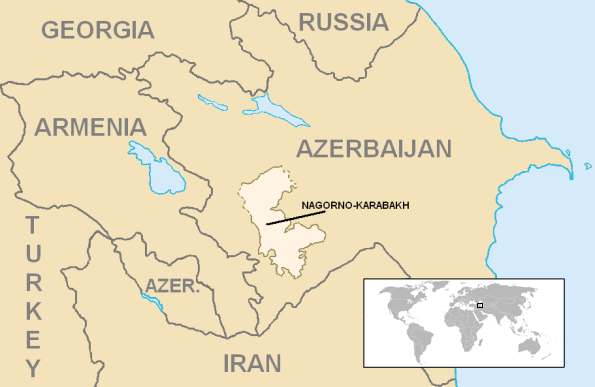
The group of Americans, and a couple Azerbaijani YLPers (the program), were boarded onto a bus and shipped off to a professional discussion by the Imagine Dialogue representatives on the Nagorno-Karabakh issue between Azerbaijan and Armenia. Quick overview: This is a section of Azerbaijan, but it is presently occupied by Armenia. In 1994, there was a war over this territory, and although there has been a cease-fire for about 20 years, no conclusions have been met and it still remains to be closed off to Azerbaijanis. In the Organization of Islamic Conference in 2008, Armenia was charged with the "destruction of cultural monuments in the occupied Azerbaijani territories," but no real offense or follow-up actions were taken. The ceasefire continues to this day to be broken, and overall, feelings towards the Armenians in Azerbaijan are extremely negative, since Azerbaijanis cannot go into 20% of their territory.


Photo from: <http://en.wikipedia.org/wiki/Nagorno-Karabakh#Contemporary_situation_.28since_1994.29>

We were never told the reason we learned about this, but I took away so many thoughts from these meetings. First, it makes me wonder what Armenia's side to it is. Why are they causing such a big deal over this piece of country land? Armenia, as a whole, must have bad feelings towards Azerbaijan too, but what exactly are their reasons? Also, this dispute has ruined so many lives, yet I had never even heard of the country Azerbaijan back home. How closed off from the worldly occurrences are we? What are solutions that can satisfy both countries? How do you break the barrier that present generations are being raised with, this hatred for another country.

To me, it seemed a bit silly that so much dislike for Armenia had been built up, even by people completely unaffected by the war. But then I thought of the Cold War and the Red Scare. The problems with illegal immigration, the Chinese Exclusion Act, Japanese internment, general racism, and all these other rather stupid things America has been involved in.

Why are humans so inclined to put up walls against others, just because of cultural background? As the Avenue Q song goes, "everyone's a little bit racist," which, undeniably, is true. We all have our moments where we think prejudice thoughts, and there really isn't anything we can do about these natural tendencies. But to act upon them, to not be able to reason through the ridiculousness of judging based on genetics, that's a serious problem that destroys the potential for any sort of worldly cooperation.

I think that the root of racism is ignorance. Ignorant parents teaching their children opinions on a race they don't know hardly anything about. But if we could educate these kids (I'd say their parents too, but kids generally have more open minds) on the struggles other parts of the world are having, have them correspond with foreign schools, educating students on what is actually happening in the world, eliminating these ideas that one way of thinking is better than another, that any religion outside of their own is stupid, that some people are above others- simple steps, really. It's so easy to open the eyes of kids who just haven't been given the chance to see the world for what it is. And who doesn't want increased understanding?

I


My Azerbaijani Host Family

So, I'm sitting there in the business center, day one in this new country, waiting for my new temporary family to pick me up.

If you haven't experienced being a host student, let me tell you what goes on in our minds: What if they hate me? What if they can't understand anything I'm trying to say? What if they completely neglect my entire existence? What do I talk to them about? What's dinner going to be like? What if I accidentally do something to offend them? What if they are terrible cooks? WHAT IF THEY ONLY HAVE A TURKISH TOILET? 

I heard my name, and the coordinator was standing next to these two ladies, seemingly the same age. Maybe sisters? Somewhere in their twenties? They were smiling, what could go wrong?

... Turns out one of them was my age, Ula. And her mother, standing next to her, I could never actually figure out what her name was. I had no idea what in the world to call her that entire trip. They never really introduced themselves, and if they did my mind was overwhelmed by so many other things I never stored a name in my mind. Soooo, I just avoided any situation I'd have to address her.

My Host sister

One thing about Azerbaijanis: They are way more stylish than anyone I've seen in America. All the time. The other day I went with bare feet and my bathing suit into the gas station, and that would sound so crazy there. No matter where we were going throughout the course of the trip, be it down the road to the little tendir (a special bread) vendor or to drop me off somewhere, there was a long process of make up application and hair styling. But man, did they look awesome. Plus, my host mother and sister were both gorgeous to begin with, so I always felt less impressive next to them, but that was okay. It was like being with models. 

When you first meet these people you've never spoken to who you're going to live with for the next while, amusingly enough no words come to mind. So I just stood there, still trying to figure out if they were sisters, while my host mom kissed me on both cheeks and spewed random exclamations of enthusiasm, which I reciprocated after coming back to the real world. 

We walked down to the car, which my host dad was waiting in, and were on our way. 

Another thing about driving in Azerbaijan: It's common to not use your seat belt. In fact, all the cars I was in had these little seat belt end attachments that plugged into where your seat belt buckle should go, so the sound didn't go off. No seat belts on, just the attachment. I found that amusing. But not when I wanted to be buckled and there was this fancy seat cover in the back, preventing any access to what I have been taught was a lifeline my whole upbringing. 

Well, when in Rome...

Then I got a big surprise. My mom, who took two months of an English class just to be able to talk to me (which still touches me. That was so sweet.) tried to explain where we were going. "Have you heard of the singer Emin?" No. "Would you like to go to a concert?" ... Now? Sure!

So with that, my sister would be accompanying me to my first concert. 

But this was not anything like an American concert. Which is why I didn't see any concern in my tee shirt, jean shorts, and crazy ponytail get up. I mean, I've been to American concerts now and that's completely normal to wear. 

It turns out ball gowns were actually quite acceptable at this here concert. Actually, everyone besides the fan club at the front of this open-air stadium filled with chairs and balloons looked like they belonged on the red carpet. And then there was me. The only white, blonde-haired, blue-eyed, and so obviously American female there. 

Azerbaijan doesn't have many foreigners visit. As in, by the end of the trip if we ever saw foreigners, we could easily pick them out and got excited over their presence. Also, Azerbaijanis have a habit of staring. Hardcore staring. In pre-orientation, we were warned of this, and to just look away. Their heads will follow you, and they didn't seem to make any effort to hide their staring. It was amusing after I was used to it, but the first night already self-conscious, I wasn't ready to be laughing at that situation. 


But it turned out to be quite a bit of fun. Concerts, at least this one, are more formal there, everyone stayed in their chairs until the end, except for between songs when fans with gifts were allowed onstage with Emin to give him their flowers or whatever, and receive a hug and a smile. It was quite charming, actually. It was more personal and touching than the more closed-off concerts here.  

After the concert, our parents picked us up and we went on a walk around the gorgeous city of Baku. This was my favorite time in the city, just walking around at night, seeing everything lit up. Because, really, everything was lit up. Blues, reds, greens, pinks, oranges, neons- it reminded me of Las Vegas but incredibly more classy. It was magical, and really can't be properly described, as hard as I may try. 

We walked along the bay of the Caspian Sea, the Flame Towers in the background lit up sometimes like flames, and sometimes like the Azerbaijani flag waving majestically to imagined wind. The breeze was blowing off the water, and my family pointed to various things and spoke in broken, but understandable, English (except my dad, who only knew a couple words) what they were, and the history behind everything. 

I noticed that you could ask almost anyone, and they knew the stories behind the city's wonders. The myth behind the Maiden's Tower, the purpose of the Flame Towers, the legend behind the window with the cat statue in Old Baku- everyone knew them. And, these things had stories to begin with. In America, there doesn't seem to be as much appreciation and interest in the little things. I mean, sure, there's always those statues you see around that may have some history, but how much does anyone care? Unless they're major historical figures, chances are few people actually know who that person is, and what they did. Without plaques, the citizens of Baku all seemed to know the stories of even the littlest details of their city. And it showed so much well-deserved pride in their country. 

I learned about my family, as well. My sister was in the equivalent of junior year in America (they only have 11 years of school), and was the translator whenever my parent's decided attempting English is a waste of time for all they wanted to say. She knew she was pretty, and every opportunity presented fixed herself in a reflection. But heck, if I looked like her, I would too. Although there was never anything wrong in her reflection. 

My mother, she tried her best to use English at all times with me. From what I understood, she was pretty high up in her business, which I think was a... Soda company? It may have been a car company. But she got free soda from her work... I don't know, she was in an office building and in meetings all day. She loved taking selfies. Like, loved it. Several times we stopped so she could take selfies with her husband. It was kind of cute, really, their poses. 

My host dad, I loved him so much. He spoke little to no English, but he didn't need to for me to understand him. He mainly stayed to himself, but once he showed me this card trick. Basically, I rearranged cards like he showed me to by demonstration, until there were four piles. My sister translated that the top cards would read my thoughts, and I flipped them over one by one. They were all Jacks. "Boys, boys, boys, boys!" my dad exclaimed, and I burst into laughter. The one word he knew was "boys." They all laughed along with me, and I still look back on this as one of the most bonding moments we had. 

Still walking around the night, sipping on the fresh-squeezed lemon-orange juice my dad bought for me from this orange-shaped juice stand, we headed back to the car around 12 am. Through the empty marble walkways, past the disco clubs pounding with heavy beats, under the dim street lights loyally showing us the way, the beauty of the city never ceases to amaze. 

My Host Parents
But the amazement flickered when the car ride came to be over 30 minutes... 40... 50... Where are we going.... You know I have to come back here by 10 am tomorrow, right? Oh, twisty dirt roads, great. Absence of buildings? I feel safe. Will someone please tell me where we're going? I started to get nervous. 

Their summer house turned out to be over and hour away from the city. The traffic from the morning crossed my mind, but I figured they knew what they signed up for. So, we ate this marvelous late dinner (they don't seem to believe in early bed times. 2/3 A.M? No problem. It was hard to keep up with.) and they showed me my room, which was so roomy and way nicer than I had dreamed of. I just, I really appreciate everything they did for me. I need to get that out there. 

Oh, they don't wear shoes in the house. I was never informed of this. I didn't notice everyone take off their shoes and exchange them for house shoes, they did it so smoothly. So when I walked in, I didn't understand the reaction from my host dad, who jumped and started exclaiming something, and my host mom gently pulled me back into the entry way and handed me some slippers. Oh. 


CULTURE TIME!

Toilet paper. Well, that wasn't a thing everywhere. Including this house. We had been warned about it, but in public places they did have toilet paper, so it didn't seem to be a big deal. I was not prepared for actually having to deal with it. 

Instead, they have this spray-hose next to the toilet. 

I'll leave you to figure the rest out. I never fully did.

*********************************************************************************

They had a shower room. Not just a shower in a bathtub in a separate room, but like, you walked in to this little closet-sized tiled walkway, shut the door, and through another door was the entire shower room, the size of a large walk-in closet. 

It took AGES to figure out how in the world to work it. And how to get it hot. And when it got super hot, how to get it cold. But it was interesting. 

The thing is, my family didn't have any reservations with me being there. I was a bit surprised when my shirtless mother walked into my room to make sure everything went fine with my shower, if I needed anything, goodnight! It definitely made me feel as part of the family, but I don't know if I needed to be that part of the family. Oh well. 

Sometimes in books, the character says "I fell asleep before my head hit the pillow." I never understood this until I got into bed that night.